

Our Great Inheritance: Comes into the Present as a Child of Europe (Part 1)
Many many Americans are tied to the once great and turbulent continent that Americans saved not once, but twice. (Resentment in the "elite" has led them to think they need not care about Humanity.

Marco Rubio today addressed Europeans about its heritage, its culture and its future at the Munich Conference. While trying to apply both tough love and mutual support, one feels that his rational position is too rational for the crazed Europeans, who see themselves in many extreme ways: victims of Russia, thus needing both protection and saber-rattling for horrific war; colonizers worthy of zero claims to heritage or culture; and destructive of the the very institutions they claim matter, yet intentionally ruin them, spit on their foundations, and tell their common people they deny themselves culture and freedoms.

Secretary Rubio harkened back to the idea - “we are a child of Europe,” us Americans. And so - given that, I will share my recent deep dive and research added to my own family’s history.
Parents & Grandparents
Like all things, we have good and not so wonderful connections in our past. There is no escaping one’s past - there is only learning how to accept those events and choices and putting them in proper perspective. I preface this because - not every close relation and cousin is someone I would recommend as worthy. Like many, our closest can be also the one’s we’d like to skin alive and set afire if enough alcohol was imbibed.
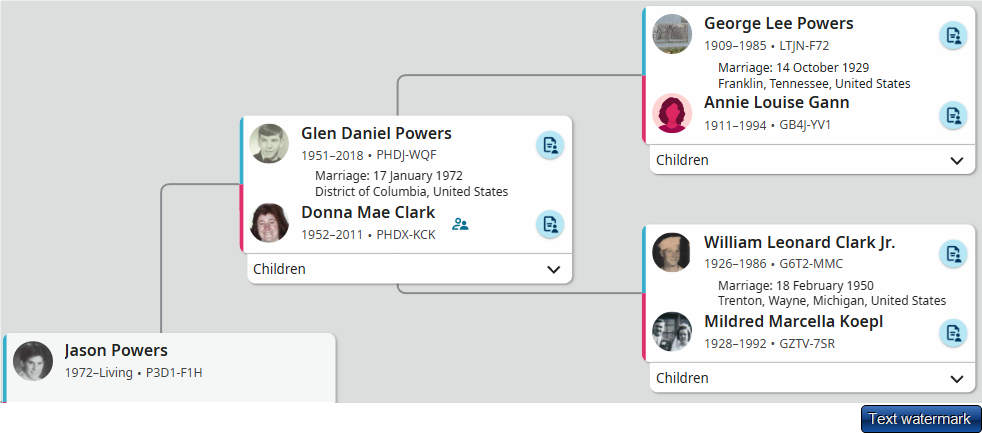
As I have written, my mother was quite extraordinary in my biased opinion. Tireless and determined, she made the best of what was a bad marriage made in a rush. She entered it just a two months after finding out “I was on the way.” I actually found out she married in Washington, D.C., after researching it.
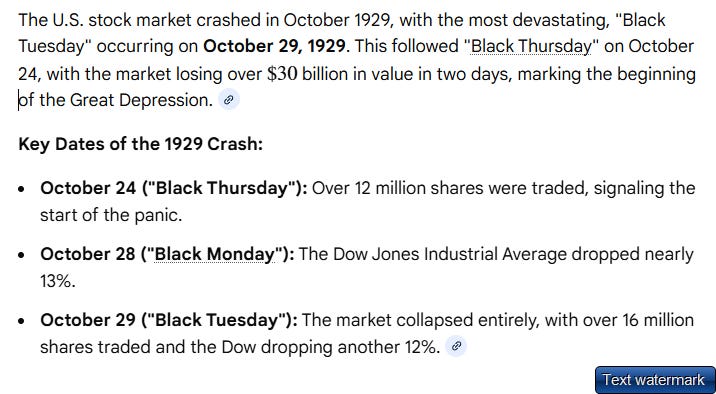
For my other biological parent, I found other marriages (short-lived and volatile) and his old high school photo - via a deep dive. Since I was down this rabbit hole, I dug on all my kin that came through Tennessee via Rockbridge, Virginia, going back to the early 1700s, with Hugh Weir, as the keystone tied to George Lee Powers (1909-85). Grandpa Powers married Annie Gann (at least 1/4 Cherokee via Oklahoma and Georgia relations) on October 14, 1929, just 2 weeks before the seeds of the Great Depression were sown. Together, they would have 10 kids over the next quarter century.
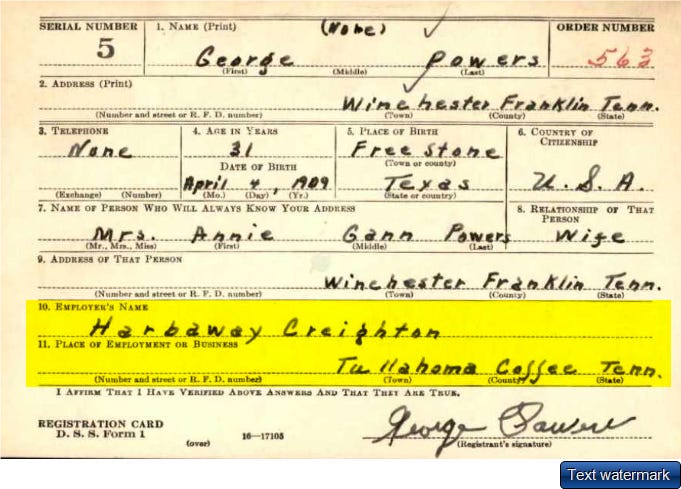
George Lee would be 31 in 1940, just before World War II. He went to work as a contractor for Hardaway (Creighton) Construction. It took some intelligence work to figure this fact out, as his draft card was not very clear. Hardaway would build up the newly renamed Camp Forrest (as in Civil War General Nathan Bedford, a relative, by marriage). I knew grandpa had worked in Nashville, according to my foggy childhood memories, so he likely worked at Creighton (as shown below) from Tennessee Encyclopedia telling of a partnership formed.
The camp served as a training facility for eleven infantry divisions, two battalions of Rangers, numerous medical and supply units, and a number of Army Air Corps personnel. In addition, the camp provided logistical support for the massive Tennessee Maneuvers conducted at intervals from 1941 through early 1945. The camp also employed thousands of civilians in various support roles and housed German prisoners of war…
The Hardaway Construction Company of Columbus, Georgia, and the Creighton Construction Company of Nashville formed a temporary partnership to build the thirteen hundred buildings, the fifty-five miles of roads, and the five miles of railroad track that made up Camp Forrest. Over 20,000 people were employed in constructing the camp…
Army trainees received instruction in house-to-house combat in the first village mock-up. The Second Ranger Battalion trained at the base and later won fame when they scaled the ninety-foot cliffs of Point-du-Hoc on D-Day.
On my mother’s side, I have mentioned and written about my grandfather and his brother Harold’s death on June 5, 1944 and my Grandpa’s Okinawa landing in his LCVP. I found other information on Grandpa William Clark, Jr. & Mildred Marcella Koepl, his Korea draft registration, their 1950 Michigan marriage license, and details on my grandmother’s Koepl family lineage tracing back to Kilstett, Bas-Rhin, Alsace, France and Antoine Steinmetz II (1767-1839).


Vive La France! Vive la liberté!!


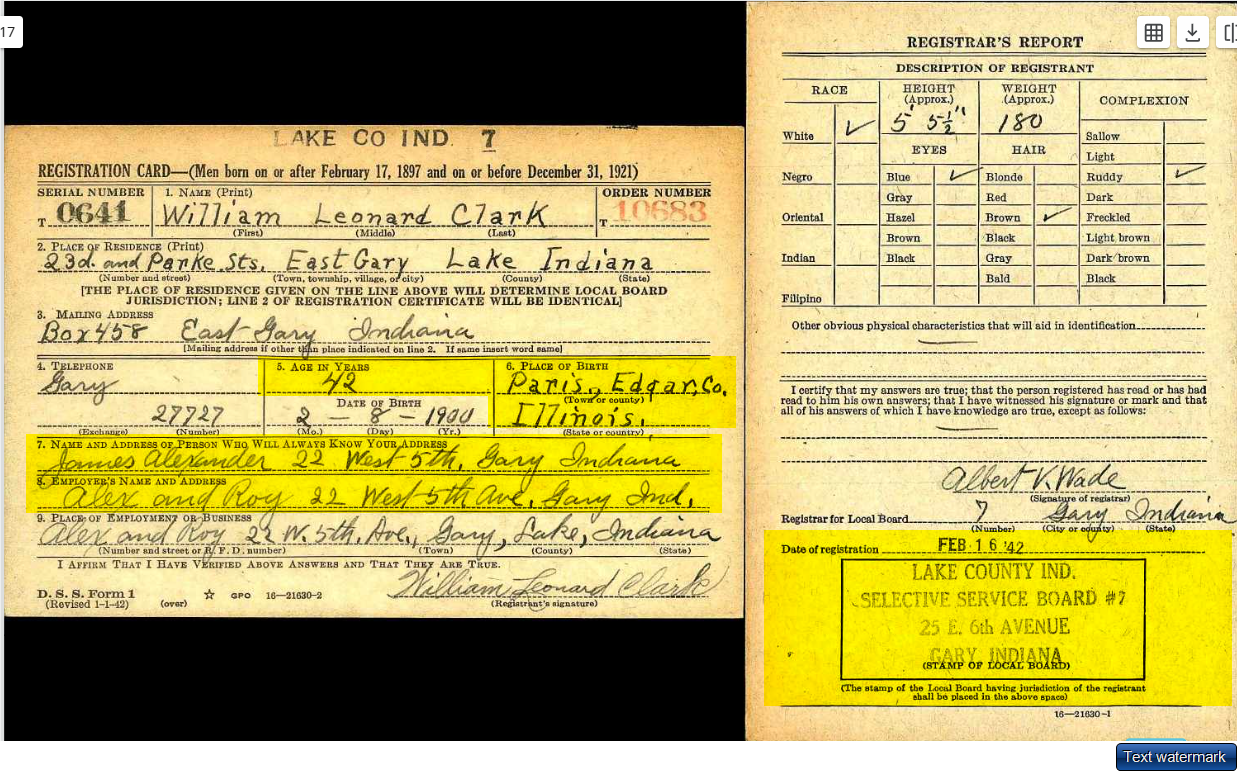
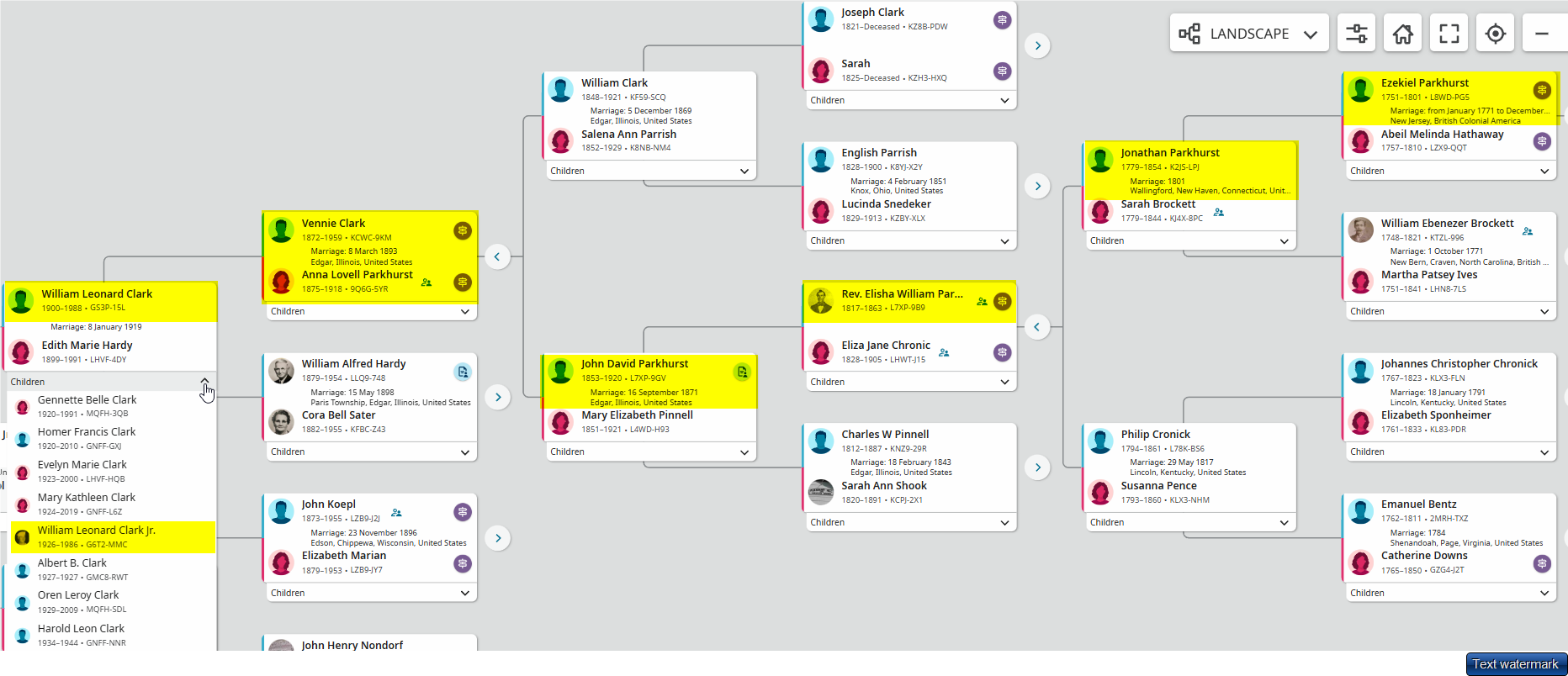
The Clark side of my family grew more interesting with the discovery of Anna Lovell Parkhurst marriage to my Not My Cousin Vennie, but my Great-Great Grandpa Clark. His youngest son, William Senior, a barber in downtown Gary, Indiana during the 1930s, outlived his namesake son, my grandfather - and the best storyteller a young boy could have - William Junior.
I knew both men - as my mother and I went out to Winamac, Indiana to visit both of my great grandparents for a few years before they left this Earth. (Great Grandpa signed up for WW2 on 2/16/42!)
THE GREAT GREAT THAT ARE GREAT?
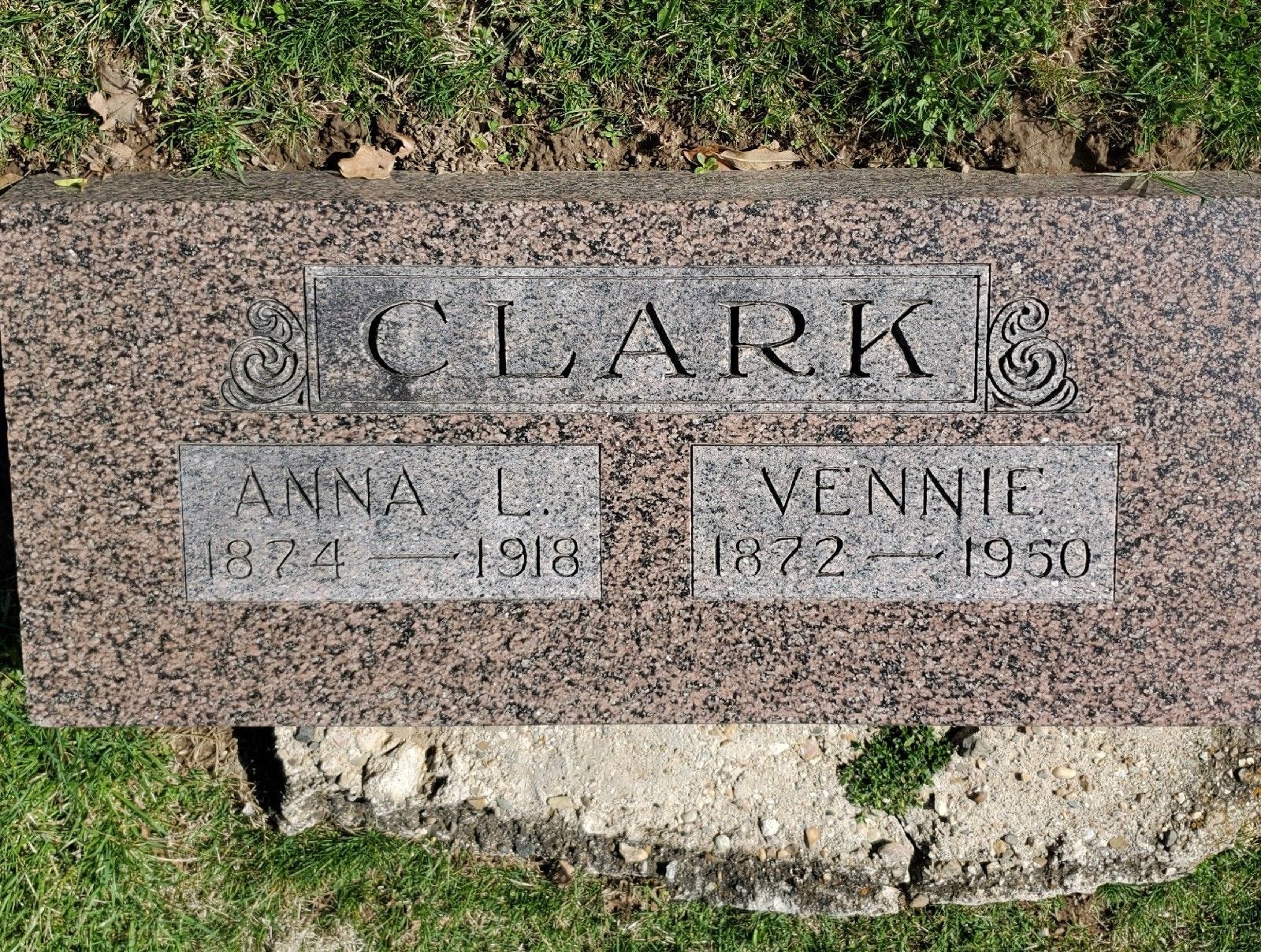
Anna Lovell died just two days before Christmas, 1918 in Cook County, Illinois. World War I had barely ended, and she was but 43. She is interred in Paris, Illinois, the same town where my grandfather was born in 8 years later. Vennie died in 1950 as William, Jr. married Mildred that year while Vennie never remarried.
Anna came from a very long line of Parkhurst that came to America sometime between 1635 and 1643, landing inside the Massachusetts Bay Colony as its 2nd generation settlers of this country, it appears. Along the path back through her potential ancestors (Rev. Elisha Parkhurst), one can see either errors in reporting, or visible mistakes (pictures that could not exist), obits with confusion/confusing details about when or where or how someone came through their life.
Another example lay in Captain William Ebenezer Brockett (1748-1821) and whether he is kin or just misappropriated into one’s family tree. If he came through Connecticut birth and early childhood, it would be more plausible, given other relationships (the aforementioned Parkhurst clan.)

Mixing up people, of the same or nearly the same name, nearly the same births and deaths (years in particular), and potentially, the same towns of residency (due to multiple families - related usually, but distinct) arising along the way, creates confusing duplicate records - and genealogical tracing is not done for a day or two.
This takes years of research, substantial visits to localities, libraries, oral (if passed on) and recorded family histories, if they can be easily found - generally not without an expert to guide one along - and thus, whatever truth there is - it takes a very long time to glean just basic details about one’s origin story. (Once one gets past their great grandparents, (if born prior or circa 1970), online records exponentially disappear - this is my Dunning-Kruger analysis.)


Back to the Parkhurst Family of New England
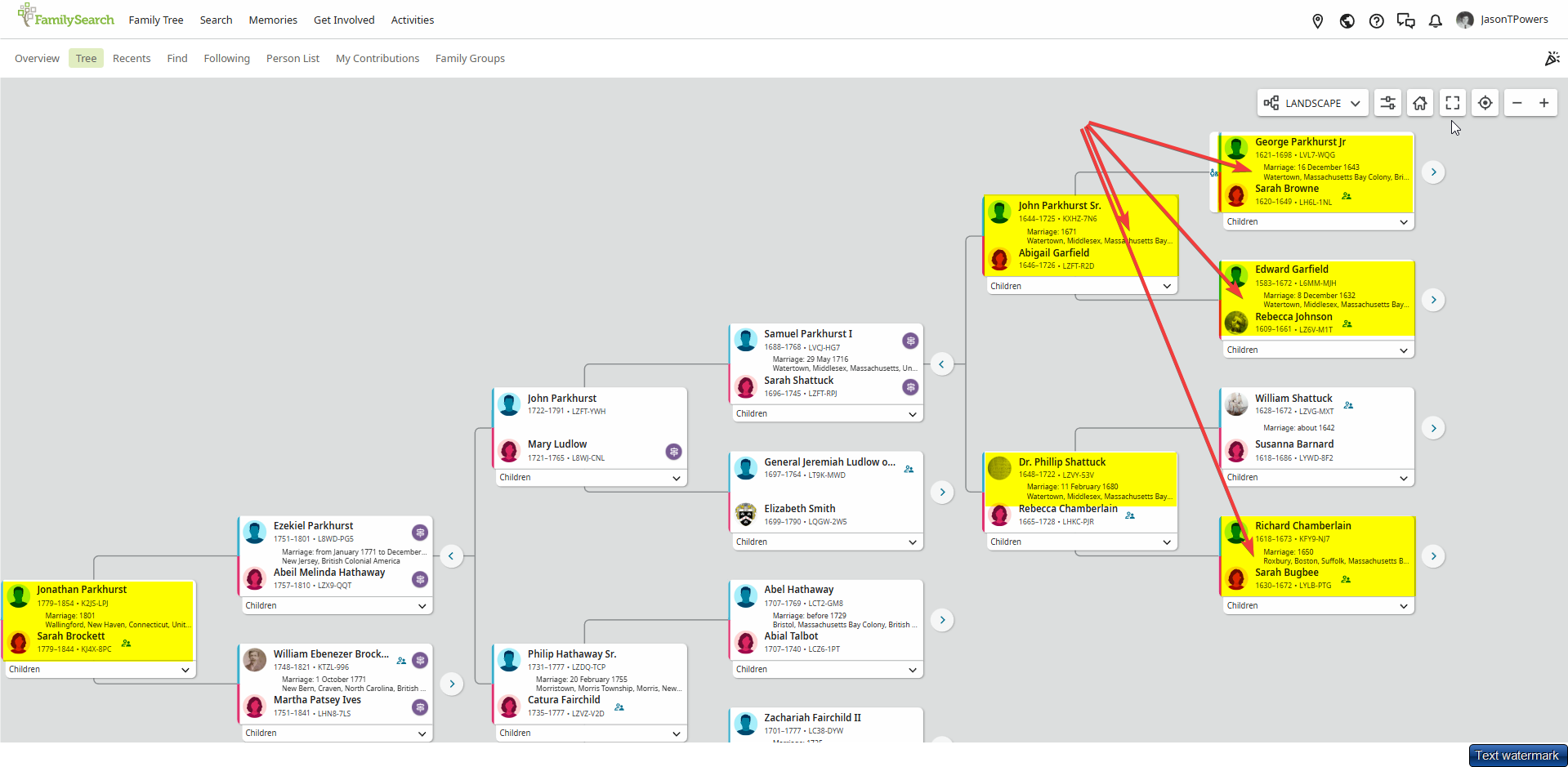
There are verified sources to these entries. The PDF attached in the genealogical history of New England Families (Volume 4). It has a whole section dedicated to the Parkhurst clan from England. (George Parkhurst SR) & (William Shattuck)
A reliable entry on Edward Garfield is also shown. BUT - controversy always comes with one’s death - and who gets inheritance when multiple families (and wives, and sons) are skipped over. Or the confusion lay in the records, the deaths, the lacking of verified proof (and first names, evidently).


Edward Garfield lived a very long life (89) and it appears two sets of families:
…we would expect to see many instances in which the father and son were distinguished by the markers of "Junior" and "Senior," but this never occurs. And the Edward Garfield who married the widow Buckmaster gave his age on 8 October 1670 as "aged ninety-four years or thereabouts" [SJC Case #2997]. When we combine these observations with the data reported above on Edward Garfield of Hillmorton and Coventry, Warwickshire, we conclude that there was only one man of that name in early New England, and that he had two sets of children, two decades and more apart, with two wives.
Edward also had an interesting way to pass on property….if a snippet is indeed on the money - BUT more importantly - the question of the ABGAIL GARFIELD marrying a PARKHURST is questioned:
Edward Garfield's bequest to "my grandchild Sarah Parkhurst" raises some interesting questions. His youngest child, daughter Abigail, is said to have married John Parkhurst. But at the time of her father's will she was still unmarried, with provision being made for the reallocation of her legacy if she should die unmarried, so this "grandchild Sarah Parkhurst" was not her daughter.
Only two women named Sarah Parkhurst have been identified prior to the date of Edward Garfield's will: Sarah (Brown) Parkhurst, daughter of ABRAHAM BROWN {1630, Watertown} and wife of the younger George Parkhurst [GMB 1:244-46]; and her daughter Sarah, born at Watertown on 14 September 1649 [WaVR. 1:14). (They had recorded an earlier child, John, born on 10 June 1644 [WaVR 1:11].}
An interesting solution to this problem is possible. In the distribution of the estate of Abraham Browne there is mention only of his grandson John Parkhurst, whereas Edward Garfield refers only to granddaughter Sarah Parkhurst. With his first wife, Edward Garfield had a daughter Sarah, baptized on 1 November 1616. The records cited here allow the possibility that George Parkhurst [JR] married Sarah Browne, that they had son John born in 1644, that this wife died, and that George then married Sarah Garfield, with whom he had daughter Sarah.This brings us back to Abigail Garfield, who is supposed to have married John Parkhurst. The reference to Sarah Parkhurst in the will of Edward Garfield does not provide support for this marriage, nor has any independent evidence been found for this event.
The marriage has been retained in this account as a probability, but a careful study of the Parkhurst family should be undertaken, both for this problem and the one discussed just above..." added by Lei Rachelle Child
Very good research. There's some evidence that a lot of people traveled through the Cumberland Gap with Daniel Boone and the Skaggs longhunters. They were taking orders for people in VA for pelts, and they were cutting roads through and encountering hostile Indians who would ambush them on the roads and burn their forts along the way, capture their women, and different things. It was pretty wild territory through there to TN. You may or may not find the route they went through. Mine came over on the ship George and Anne. One of mine on the maternal side helped establish Providence, RI. They had Revolutionary War service and land grants to settle the Country and produce crops. Some were granted land for military service. My Erwin line went from SC, NC, to TN because of a land grant for military service, so you might find that too. The man & his family that came here first farmed vegetables, tobacco, and hemp, and logged and made barrel staves to ship on the railroad because everything was stored in barrels. They brought 2 slaves with them that were wedding gifts. There is a cemetery with a slave portion in it. He had a vast amount of land, either 16,000 or 160,000 acres, but it was divided up between his children and passed down. He had been a storekeeper in VA prior to coming here. The rest of his family I think moved to TN, but he went his own way, and his wife was from VA, so that could have been why he didn't go with them. Thanks for sharing.